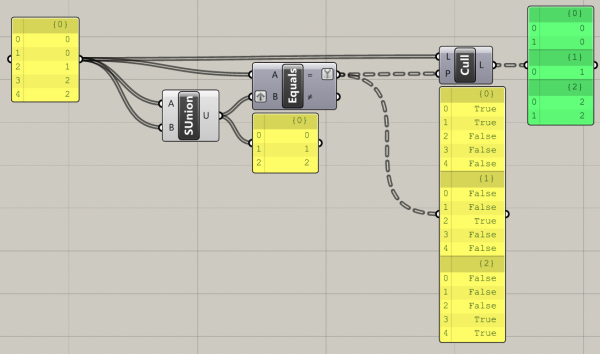
This is my self-explanatory solution to the problem (Union all of the data, and put them in each branch wether match or not). I decided to post this 2013 solution of mine after watching a 2014 C# tackling of the problem.
This is my self-explanatory solution to the problem (Union all of the data, and put them in each branch wether match or not). I decided to post this 2013 solution of mine after watching a 2014 C# tackling of the problem.
While using Grasshopper, I’ve been many times confronted with the task of smoothly varying a list of number to achieve some formal effect through number control. Be it a curvature or height control, the problem here deals with easily transforming a list of numbers into another with some of the values smoothly changed. I decided […]
If you use MacOS like me, and seem to depend on Quick Look for every file related task, you would feel GPX files could get a little love. And that is just what Vidar Bronken Gundersen did, he created a GPX Quick Look plugin which you can download from his GitHub page. If you install […]
I use kumu for research, which enables me to organize information and find interesting relations through clusters. For a clear organization of all the information, I input everything in a spreadsheet, much like in a database. I even include the images in the Google spreadsheet as URL’s, that kumu then renders in nice round thumbnails. Sometimes […]
I created a quick Google Sheet to calculate the end time of a process based in the percentage done and time elapsed. Free for anyone to use! Google Sheet – Process time calculator
The AVG daytime is the temperature average from 7:00 to 20:00.
Grasshopper does not seem to have the “pick region” feature from the Rhino Hatch command. I have created such an algorithm, taking advantage of recursive computing provided by the Hoopsnake plugin. You can download the .gh file here: FindRegion.gh The overall idea of the algorithm is to find the curve that has the shortest angle relative […]
Contrary to most people I meet, I am a Magic Mouse fan. I never had any wrist pain, and I love the 2D touch scroll. Having said that, the mouse comes with some incompatibilities with graphical software packages, namely Blender and Rhino Grasshopper. This post is about the latter. To make the Grasshopper canvas Zoom […]
You can reach here for the interactive chart. The COVID-19 outbreak has been the subject of various studies and infographics. One of the most used is the Visual Dashboard by Johns Hopkins CSSE. I created this tool because I wanted to be able to compare statistics between two countries, and I haven’t found any tool […]
A friend of mine who has been a long time SketchUp user has recently asked me how to do push pull in Rhino. Here is my take: Execute the command SplitFace If you want to split by a line, simply draw it (activate Near or other OSnap recommended) You have the option to split by an existing (previously drawn) […]
One of the features I have learned to love in Rhino is the Print to JPG feature. Unfortunately, this is still not available to Rhino 5 for Mac users, but there is a solution. The secret is using the ViewCaptureToFile command in its command line variant, -ViewCaptureToFile. From here, you can type the full path or […]
All content © Copyright 2026 by Pedro de Azambuja Varela.
Subscribe to RSS Feed