This definition is the interior of a cluster I created that allows for the culling of duplicate items of any type based on a criteria. In this case, we are culling lines based on their mid point. Use the criteria carefully.
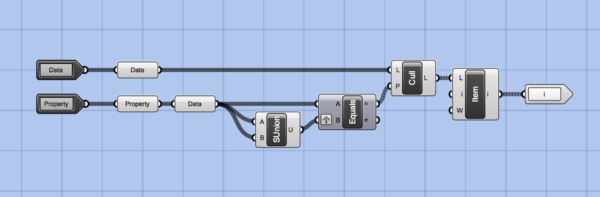
This definition is the interior of a cluster I created that allows for the culling of duplicate items of any type based on a criteria. In this case, we are culling lines based on their mid point. Use the criteria carefully.
A common question I get is: how to replicate a “if then else” statement in Grasshopper. Here is my take. Explanation: if “First Number” is larger than “Second Number”, then output A, else output B. Or: if (FirstNumber>SecondNumber) {A} else {B}
It is quite common to find people confused by the notion of DPI and its influence in media size. DPI is nothing else than the relation between virtual dimension (pixels) and real dimension (inches/centimeters). To ease this understanding and everyday calculations, I created this simple spreadsheet in Google Docs accessible to anyone. You just need […]
I use kumu for research, which enables me to organize information and find interesting relations through clusters. For a clear organization of all the information, I input everything in a spreadsheet, much like in a database. I even include the images in the Google spreadsheet as URL’s, that kumu then renders in nice round thumbnails. Sometimes […]
This is my take to the problem of splitting multiple curves in their intersections. There may be other approaches, and there are even components inside plugins that do this, but I wanted to have my own in-house solution so I could understand what is going on. The image on the left shows the original 7 […]
If you use MacOS like me, and seem to depend on Quick Look for every file related task, you would feel GPX files could get a little love. And that is just what Vidar Bronken Gundersen did, he created a GPX Quick Look plugin which you can download from his GitHub page. If you install […]
Another take on the problem of shaping a list of numbers according to a graph visual definition. The reason for not applying a Graph Mapper component directly deals with the way Graph Mapper has its settings adjusted. These are accessible through a double-click on the component, disallowing any kind of parametric adjustments (as with the […]
This Blender add-on is a fork I modified from the original “Import Wavefront (.obj)” which ships with the official Blender release. The motivation for the creation of this modification is the maintenance of materials upon importing new geometry. A common workflow in architecture visualization is the iterative import of exported models from other software, such […]
While using Grasshopper, I’ve been many times confronted with the task of smoothly varying a list of number to achieve some formal effect through number control. Be it a curvature or height control, the problem here deals with easily transforming a list of numbers into another with some of the values smoothly changed. I decided […]
Researching implies producing lots of PDF’s. Sometimes these PDF’s are exported without much control and become several MB large, which is inconvenient to send out to some else (e-mail) or even to the cloud or a printer. To deal with this issue, a common solution is to down sample the images in your PDF to […]
One of the features I have learned to love in Rhino is the Print to JPG feature. Unfortunately, this is still not available to Rhino 5 for Mac users, but there is a solution. The secret is using the ViewCaptureToFile command in its command line variant, -ViewCaptureToFile. From here, you can type the full path or […]
All content © Copyright 2026 by Pedro de Azambuja Varela.
Subscribe to RSS Feed