Poster presented in the Nexus 2012 – Relationships Between Architecture and Mathematics. This presentation was about the relation of a complex geometry with constructive constraints.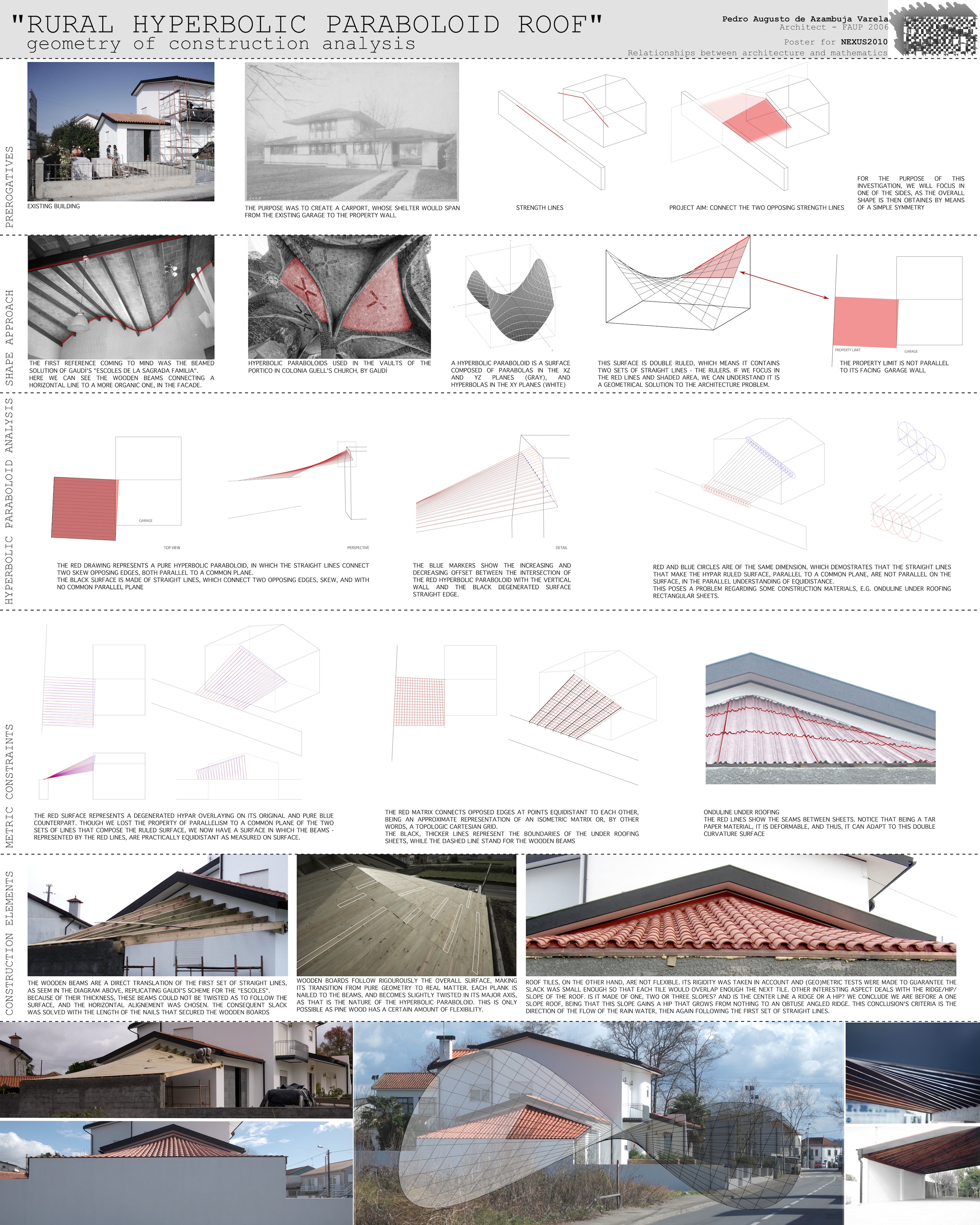
Poster presented in the Nexus 2012 – Relationships Between Architecture and Mathematics. This presentation was about the relation of a complex geometry with constructive constraints.
Publication and communication of article “Genetic Algorithms in Architecture – History and Relevance”. Lecture in April 2013
This workshop was lectured at Istanbul Technical University. A collaboration between FAUP’s DFL and ITU’s ArfLab, the vault was built with stereotomic rammed earth voussoirs.
This work was the result of my studies at CEAAD – Curso de Estudos Avançados em Arquitectura Digital – organized by ISCTE-IUL and FAUP, and hosted in ISCTE-IUL and VFABLAB in Lisbon in 2013-2013. When approached with a raw material such as expanded cork agglomerate, materiality is a concept that is present from the very […]
Between the geological earth and the rubble turned ground, architecture happens. It is in the cycles that happen between those two moments that the Flying Earth proposal is developed. Addressing the Trienalle challenges, it explores how the Earth’s most sourceable matter may provide the human being with an infinitely available and carbon-free material, contributing to […]
Stone Translucent Verticalities is an architectural sculpture that highlights the potentialities of stone/marble digital design and fabrication combined with artificial lighting. The main theme of the design is the relationship between sculpted lithic materials and translucency: in fact, by reducing thethickness of the stone at certain points, light can pass through the matter and allows […]
An experiment within the DFL. Project coordination: José Pedro Sousa Design team: Pedro de Azambuja Varela, Pedro Martins Photographs: Carlos de Albuquerque Castro
The School of Architecture of Aarhus organizes the HARD CO(u)R(s)E DIGITAL, a set of workshops focused in digital technologies in a pre-holiday format. The key factors in the CorkVault workshop were the use of ICB (Insulation Cork Board), a 5-axis waterjet cutter and Kangaroo along with Grasshopper, so that a full-scale pavillion could be built. […]
Architecture project by Pedro de Azambuja Varela, Maria João de Oliveira and Emmanuel Novo. Following the 2012/13 edition of the Advanced Program in Digital Architecture (CEAAD), promoted by FAUP and ISCTE-IUL, the company AMORIM Isolamentos challenged the Course to design their Pavilion for the CONCRETA 2013 Fair. The students that developed their final research on cork […]
Architectural models are usually very good at representing space and rather bad at representing time. We can model a wall, a roof or an entire building in detail, but it is much harder to ask a simple historical question: what existed here in 1700? Historical Time is a small experimental add-on I developed for Blender. […]
A renewed interest in stereotomy, narrowly entwined with digital technologies, has allowed for the recovery and proposal of new techniques and expressions in this building approach. A new classification scheme for stereotomy research allows for the framing of various aspects related to this discipline, including a newly developed fabrication system specially tailored for the wedge-shaped […]
All content © Copyright 2026 by Pedro de Azambuja Varela.
Subscribe to RSS Feed